Franz Biberkopf’s transformation and rebirth
Berlin AlexanderplatzFranz Biberkopf’s transformation and rebirth is the novel’s passage from personal collapse to a guarded return among other people. In Buch Asylum, the former Franz Biberkopf gives way to a new person: outwardly weak and still carrying the same identity papers, but no longer ruled by the belief that every misfortune is simply fate. His recovery does not erase his past. It changes how he understands responsibility, isolation, and the need to remain alert to what others face.
Collapse and the End of the Former Franz
The change begins with a complete inner defeat. The narrative says that everything in Franz Biberkopf succumbs and that he keeps nothing back. His suffering is presented not as a passing setback but as a breaking point, after which the established identity of the man who had tried to master his circumstances can no longer hold. The account slows around pain and insists on its force, making collapse the necessary threshold of the transformation rather than a brief obstacle on the way to recovery.
In the evening, Franz Biberkopf believes Death is coming. He receives again the figures and memories bound to the life he has lost: Otto Lüders, Reinhold, Ida, and Mieze. He weeps and recognizes himself as guilty and less than fully human. The scene gathers earlier relationships into a reckoning; the past does not arrive as a sequence of explanations but as people and faces he can no longer keep at a distance. His former self is declared dead, while another man lies in the bed. This new person has the same identity papers and resembles Franz Biberkopf, but the narrative distinguishes him as someone who bears another name in another world. Rebirth is therefore a rupture in identity, not a return to the old confidence.
Silence, Memory, and the Investigation
The change remains visible in the new person’s difficulty speaking about the past. When he begins to focus his eyes and talk, detectives question him about his record while doctors seek a diagnosis. He learns that Reinhold has been caught and is asked about the earlier affair at Freienwalde. The questions meet a profound resistance: he needs them repeated, remains silent, and cannot readily travel back into that history. The narrative describes a mental block, and his frightened stillness contrasts with the impulsive action that had marked his former life.
The following day, he gives a statement to the detective inspector. He denies involvement in the Freienwalde affair and says that Reinhold would be mistaken if he claimed otherwise. Asked for an alibi, he cannot provide it immediately; information comes only in fragments, accompanied by visible distress. Yet he does not say anything that would incriminate Reinhold. This silence is not presented as proof of innocence or as a simple return to the old code. It shows how thoroughly the new person resists being drawn back into the former life, even when the investigation presses him to reconstruct it.
The doctors’ understanding also changes. Catatonia recedes as the leading diagnosis; they identify psychological trauma followed by a coma, rather than a feigned condition. The book places this explanation beside the detectives’ continuing interest in the old case, marking the gap between institutional questioning and the patient’s capacity to answer. The new person is still surrounded by consequences from the life of Franz Biberkopf, but his recovery cannot be measured solely by how quickly he supplies a usable account of it.
Leaving Buch and Seeing Berlin Anew
The departure from Buch Asylum repeats an earlier escape while reversing its terms. The first house Franz Biberkopf left was Tegel penitentiary. Then, the journey into Berlin had been accompanied by fear and a world that seemed unstable; he needed time before he could make a fresh start. Now the man leaving the secure house is weak, but the buildings do not move around him. At Stettiner Bahnhof, the Baltikum Hotel stands firm, and he can walk beneath the roofs without seeking refuge in dark courtyards.
His route gives the return its concrete measure. He moves slowly along Invalidenstrasse, past Ackerstrasse and toward Brunnenstrasse, passing the yellow market hall. He looks calmly at the shops, houses, and people moving through the streets. The familiar city is not presented as newly harmless; rather, he can now occupy it without the earlier sensation that it is collapsing around him. The repeated image of leaving a house of imprisonment links release from custody with release from a more inward confinement, while the changed perception of the streets makes recovery visible in ordinary movement.
Work, Companionship, and a Changed Idea of Fate
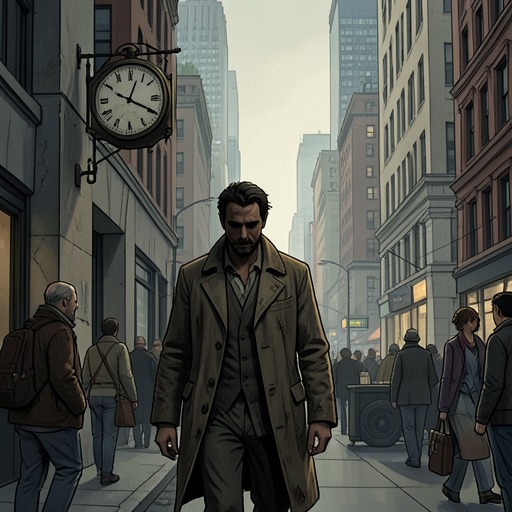
After Reinhold’s trial, Franz Biberkopf accepts a part-time job as a doorman at a medium-sized factory. The role is modest and sharply different from his former identity as a transport worker, burglar, pimp, and killer. He takes numbers, checks cars, and watches who enters and leaves. The book offers no grand career or dramatic public vindication; the change is registered in the steadiness of a job and in his place among other people. He is no longer standing alone on Alexanderplatz, with people on every side of him and moving past him.
The narrative makes companionship the practical correction to his old isolation. Misfortune, it observes, comes of walking alone; being with others requires listening, because what affects them can affect him too. From that shared exposure, he can better recognize who he is and what he might try to do. The image of a ship needing a large anchor gives this dependence a firm shape: a person, too, cannot exist securely without many others. This is not a promise that a group can prevent every blow, but a new understanding that experience and resistance need not be solitary.
His altered view of fate follows from that understanding. He remains aware that war, gas attacks, hail, and rain may arrive beyond an individual’s control. But he no longer treats every danger as an unavoidable destiny that should be accepted or glorified. Some conditions cannot be prevented; others can be anticipated and resisted. The repeated demand to keep his eyes open turns vigilance into a discipline, while the warning that many people belong together connects attention to collective survival. His transformation is therefore neither a claim of total control nor passive resignation: he must recognize what is happening and act where action remains possible.
The ending is deliberately limited. Franz Biberkopf has work, a place among other people, and a more cautious understanding of words and danger, but the narrative does not suggest that his past has vanished or that the world has become safe. His rebirth consists in a changed relation to it. The man who once rushed forward alone now sees that other people’s struggles are connected to his own, and that living with open eyes means more than enduring what fate delivers. It means refusing to confuse preventable harm with destiny, and learning that strength changes when it is shared.